Mima
2025
4 months
Prompt Detection of Postpartum Depression

PROBLEM & CHALLENGE
SOLUTION

Personalized continuous tracking
It monitors mental health throughout pregnancy and the first year postpartum with personalized check-ins.
Reassuring safe space for vulnerable users
It offers a calm, welcoming space for overwhelmed and exhausted new mothers on their perinatal journey.
PROBLEM AREA
Postpartum Depression, a real and neglected problem

Despite being a common and serious mental health condition, PPD remains widely underdiagnosed and undertreated.
Through desk research, I discovered that pregnant and postpartum women need reliable mental health monitoring to detect postpartum depression early. Without it, there are serious consequences for mothers, babies and families.
CHALLENGES
The challenges of designing for overwhelmed mothers

Extracting mental health information regularly from mothers who are already overwhelmed and exhausted meant solving these challenges:
Getting honest answers from users who might be afraid to admit their symptoms.
Making the experience feel effortless for very busy users.
Filling the gap between detecting symptoms and helping users get a diagnosis.
GOALS
The foundation of Mima
The main goal was to create an easy-to-use mental health tracker for overwhelmed and exhausted new mothers that fills the gap in postpartum depression detection without adding stress.
While learning more about the problem and the user, I set these six goals to guide my design proposal:

RESEARCH
So, why does PPD go unnoticed?
What is PPD and when does it start?
Postpartum or perinatal depression is a depressive disorder that starts during pregnancy or within the first year after childbirth. It's different from the "Baby Blues," which are mood changes in the first two weeks after birth.
Researchers still don't fully understand what causes it.

How is it diagnosed?
There are two main ways to diagnose it:
When there is a positive result in a EPDS or a PHQ-9 screening test.
When 5 depressive symptoms are present for at least 2 weeks.
But here's the problem:
Women often go unscreened during the first year after birth, and many hide their feelings due to shame or fear of judgment. This is made worse by the fact that PPD symptoms don't always look like typical depression. Additionally, many OB-GYN doctors lack the training and confidence to diagnose it.
These interconnected barriers create a cycle where mothers suffer in silence without getting the help they need.

What do mothers actually experience?
I interviewed 5 women who had experienced PPD. Mothers become so overwhelmed they don't realize what's happening. When they do realize, shame keeps them silent because motherhood should be joyful.
But they need someone they trust to check in and guide them. Without that support, they're too exhausted to reach out for help themselves.

Conclusion from the research
There is a need to regularly check on perinatal women throughout pregnancy and the first year of postpartum to uncover PPD symptoms, taking into account her previous and recent risk factors.
DECISION 01
Pairing tests and wellbeing check-ins for reliable data
To diagnose PPD, it's necessary to express depressive symptoms in a traditional PPD test or to observe these symptoms during two weeks excluding the baby blues weeks.
But these mothers may not tell the truth during screening tests. They might be afraid of being judged or worried that someone will take their baby away from them.

My solution was to pair two types of ways to collect that data:
Traditional PPD tests to get a formal diagnosis.
And wellbeing check-ins related to external symptoms that are easier to observe and to admit.

With this combination, users were more likely to give honest and reliable answers. But now the question was how to extract critical information from these overwhelmed mothers.
DECISION 02
Low effort answers with sliders
The EPDS test is one of the official ways to diagnose postpartum depression. It's a self-reported questionnaire typically administered during prenatal, pediatric or postpartum visits.
Although the test contains only 10 questions and takes approximately 5 to 10 minutes to complete, the effort required to understand and answer each one can feel overwhelming for an exhausted new mother.

I wanted both the PPD test and wellbeing check-ins to feel effortless, so I needed to find an interactive element that was very easy to use for both.
Exploration:
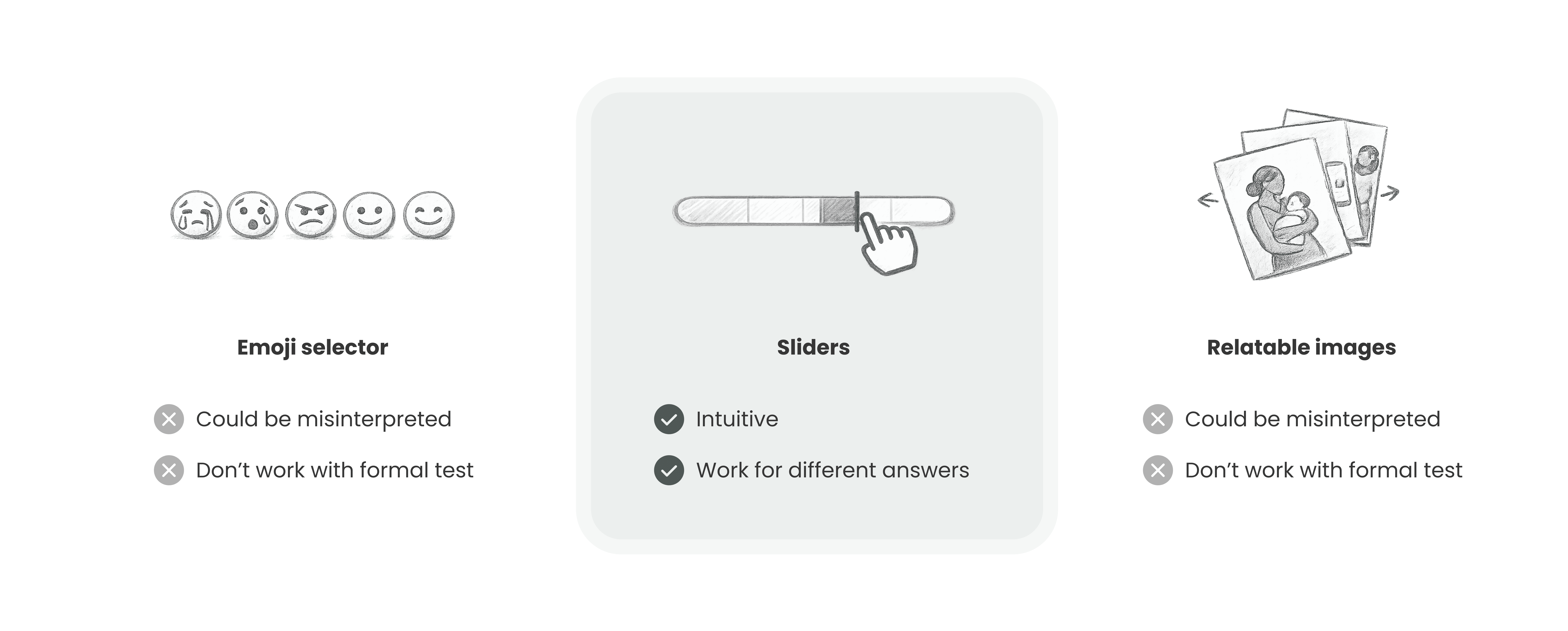
I explored three alternatives: using emojis to represent emotions, using sliders, or showing images of mothers for users to identify with. But I realized that emojis and images could be misinterpreted and they couldn’t properly work with a formal screening test.
Sliders emerged as the solution that solved both problems.
How the sliders work:
Sliders in formal screening tests
For PPD screening test questions, users slide left to indicate disagreement and right to indicate agreement.

Sliders in wellbeing check-ins
For wellbeing check-ins, sliders use vertical or horizontal mapping where left or bottom represents low intensity and right or top represents high intensity. This aligns with how people naturally understand quantities and emotional states.

Usability testing confirmed that users found sliders intuitive and easy to use. It was time now to think about the possible use cases in order for the information to arrive to arrive to their healthcare provider.
DECISION 03
Building consistency through a rewarding experience
Consistency is critical for early detection of postpartum depression. But how could we motivate mothers to come back regularly when they're already exhausted and overwhelmed?
I wanted to design a experience that felt rewarding to give them a reason to return.
Infusing positivity with illustrations and encouraging feedback
After completing a test or check-in, users receive an illustration that resonates with their experience as a new mother. I created these illustrations using AI, inspired by the book "Good Moms Have Scary Thoughts" by Karen Kleiman, which validates the difficult and often shameful feelings mothers experience.
She can also access the results page that would display encouraging graphs highlighting her progress over time.

This combination of emotional support through illustrations and positive feedback could help mothers feel motivated to return to the app and stay committed to their mental health monitoring.
RETROSPECTIVE
Low-effort tracking, strong outcomes
Insight gathered during a usability test

What could come next
Some of the next steps to work on would be:
Designing a chat section: I initially planned a chat feature for mothers to connect with advisors or join group discussions. However, I prioritized symptom tracking instead because early detection is more urgent.
Including healthcare providers as users: While focusing on mothers as primary users, I recognized the importance of supporting healthcare providers. In future iterations, my plan was to design a separate provider portal where they can access patient data and connect women with specialists.

What this project taught me
During the whole design of Mima I realized that only by truly understanding the problem and needs of postpartum depressed women, I was able to design, test, and refine a solution with the potential to support the early detection of postpartum depression.
Hey! You made it to the end